Click here to Go back to Home
How Generative AI is Reshaping Performance Marketing?
Generative AI isn’t just a 2020s concept anymore; it’s a current powerhouse in the performance marketing world that’s creating a paradigm shift. It’s entirely changing how brands connect with their customers, target them and create breakthrough campaigns that surpass expectations. Rather than taking human ingenuity to task, AI is a great tool to help us build for something more high-end, because our business capability is not so bad at what we are used to; higher-level strategy is needed for innovation and innovation at level one.
Let’s think about fundamental ways Generative AI makes a difference and how to model a hybrid model that can realize it’s potential.
The Hybrid Model: AI & Human Synergy for Growth
The best way to utilize Generative AI in performance marketing isn’t to try to choose one option over the other; rather, to use them from one angle- a bit- to make the most of the combined possibilities. This “Hybrid Model” places Growth at the centre of that dialogue- the fusion and exchange of AI with people’s expertise.
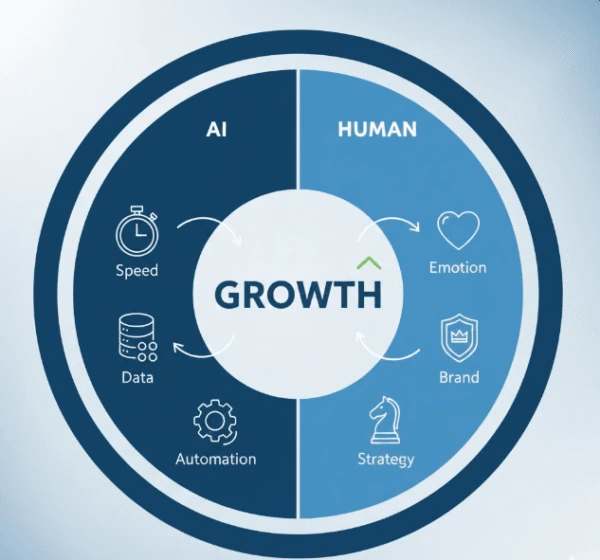
AI’s Role:
Speed: Generative AI can produce vast amounts of content, analyze data, and execute tasks at a pace humans cannot match. This accelerates campaign development and optimization cycles.
- Data: AI excels at processing and deriving insights from massive datasets, identifying trends and patterns that inform strategic decisions.
- Automation: Repetitive and time-consuming tasks, from ad copy generation to initial design variations, can be automated, freeing up human resources for more complex work.
Human’s Role:
- Emotion: Humans bring empathy, understanding of cultural nuances, and the ability to craft narratives that resonate deeply with audiences on an emotional level.
- Brand: Maintaining brand voice, identity, and consistency across all touchpoints requires human oversight and strategic direction.
- Strategy: While AI can inform strategy, the overarching vision, long-term planning, and intricate decision-making remain firmly in the human domain.
Together, this hybrid model creates a powerful loop where AI handles the heavy lifting of generation and analysis, while humans provide the creative direction, emotional intelligence, and strategic oversight necessary for true innovation and sustainable growth.
The AI Workflow: From Idea to Scaling
Integrating Generative AI into your performance marketing workflow can streamline processes and dramatically improve output. Here’s a typical branded workflow:
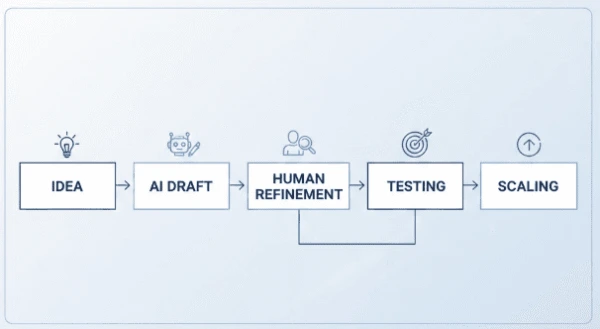
Idea Generation: This phase begins with human strategists brainstorming core campaign concepts, target audiences, and key messages.
AI Draft: Leveraging these initial ideas, Generative AI tools quickly produce a multitude of drafts. This could include variations of ad copy, image concepts, video scripts, or landing page layouts. The goal here is quantity and speed, generating a broad spectrum of possibilities.
Human Refinement: This is where the human touch becomes critical. Marketers review the AI-generated drafts, selecting the most promising options. They refine the content to ensure it aligns with brand voice, resonates emotionally, and meets strategic objectives. This involves editing, adding nuanced language, and ensuring brand consistency.
Testing: The refined content is then put to the test. A/B testing and other experimentation methods are employed to gauge audience response and performance metrics.
Scaling: Based on test results, the winning variations are identified and scaled across various platforms and channels. This data-driven approach ensures that only the most effective content reaches a wider audience, maximising ROI.
This cyclical process allows for continuous improvement, with insights from testing feeding back into the refinement phase, further optimizing future AI drafts and human contributions.
Amplifying Creative Volume and Impact
One of the most significant benefits of Generative AI is its ability to increase the volume and diversity of creative assets dramatically. Instead of spending days developing a handful of ad variations, AI can generate dozens, if not hundreds, in a fraction of the time. AI-driven targeting enables highly personalized ads, improving engagement and conversions.
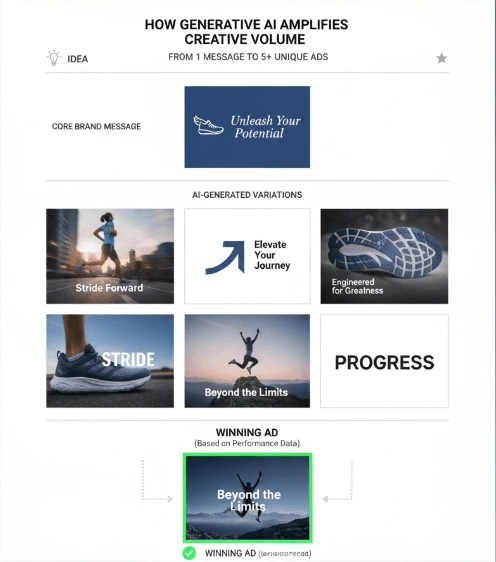
Imagine starting with 1 core brand message – for example, “Unleash Your Potential.”
Generative AI can then rapidly produce 5 or more unique variations of ad creatives around this message. These variations could include different headlines, visual styles, calls to action, or even entirely different narrative angles, all stemming from the initial concept.
This abundance of options provides a critical advantage. Instead of relying on a few hand-crafted ads, marketers have a wealth of diverse creatives to test. Through rigorous performance data analysis, they can then identify the 1 winning ad that resonates most effectively with the target audience and drives the best results.
This process significantly reduces the time and resources traditionally spent on creative development while increasing the probability of discovering highly impactful campaigns. It’s about working smarter, not just harder, to achieve marketing success.
Key Takeaways
- Efficiency at Scale: Generative AI automates content creation, allowing marketers to produce more diverse assets faster and more efficiently.
- Data-Driven Creativity: AI provides insights that inform and inspire creative decisions, leading to more effective campaigns.
- Enhanced Personalization: With the ability to rapidly generate variations, marketers can deliver highly personalized content tailored to individual audience segments.
- Focus on Strategy: By handling repetitive tasks, AI frees up human marketers to concentrate on high-level strategy, brand building, and creative refinement.
Frequently Asked Questions (FAQs)
Will Generative AI replace human performance marketers?
No, Generative AI is a powerful tool designed to augment human capabilities, not replace them. It handles repetitive and data-intensive tasks, freeing up human marketers to focus on strategy, emotional connection, and creative oversight. The “Hybrid Model” is the most effective approach.
What types of content can Generative AI create for performance marketing?
Generative AI can create a wide range of content, including ad copy (headlines, body text), social media posts, email subject lines, blog outlines, initial image concepts, video scripts, and even entire landing page layouts.
How does AI help with A/B testing?
AI can rapidly generate numerous variations of ad creatives, headlines, or calls to action. This allows marketers to conduct more comprehensive A/B tests with a wider range of options, quickly identifying the most effective elements based on performance data.
Is Generative AI expensive to implement?
The cost varies depending on the specific tools and platforms used. Many AI marketing tools offer flexible pricing models, from free tiers to enterprise solutions. The ROI from increased efficiency and improved campaign performance often outweighs the investment.
How can I ensure brand consistency when using Generative AI?
Human refinement is crucial. While AI can generate drafts, human marketers must review and edit the content to ensure it aligns perfectly with the brand’s voice, tone, and overall identity. Implementing clear brand guidelines for AI is also vital.
Sources
About the Author
This article was written by Parvathy Vinod, a Kerala-based Digital Marketing Strategist and Web Designer specializing in SEO, AI-driven marketing, and conversion-focused websites & content strategy.
Learn more about my experience and projects on the About Page