Search engines are no longer just digital libraries; they have evolved into digital assistants
If you look back at how we searched just a few years ago, it was a game of fragments. We typed “best digital marketing strategist Kerala” and sifted through a dozen blue links. In 2026, that behavior is a relic. Today, users ask, “Who is the best digital marketing strategist for small businesses in Kerala?” and expect a definitive, conversational answer – often without ever visiting a website.
Welcome to the era of AEO (Answer Engine Optimization). If your content isn’t structured to answer, your brand is effectively invisible.
The Great Shift: From Links to Solutions
A “Zero-Click” reality defines the search landscape in 2026. AI-generated summaries now sit at the peak of every search results page, synthesizing information from across the web into a single, cohesive response.
Why the Old Playbook is Failing:
-
- AI Overviews: LLMs (Large Language Models) provide the answers immediately, satisfying users’ curiosity on the search page.
-
- Voice & Ambient Search: With the rise of wearable AI and smart devices, search is conversational. People talk to their tech; they don’t “keyword” it.
-
- Intent over Information: Users no longer want a list of options; they want the best option vetted by the engine.
What is AEO? (And No, SEO Isn’t Dead)
Answer Engine Optimization (AEO) is the strategic practice of structuring your digital presence so that AI models and search engines can easily extract, synthesize, and credit your content as the definitive answer.
It is important to understand that AEO is not replacing SEO; it is the evolution of it. While SEO builds the foundation of your site’s health and relevance, AEO refines that content in a way AI “thinks.”
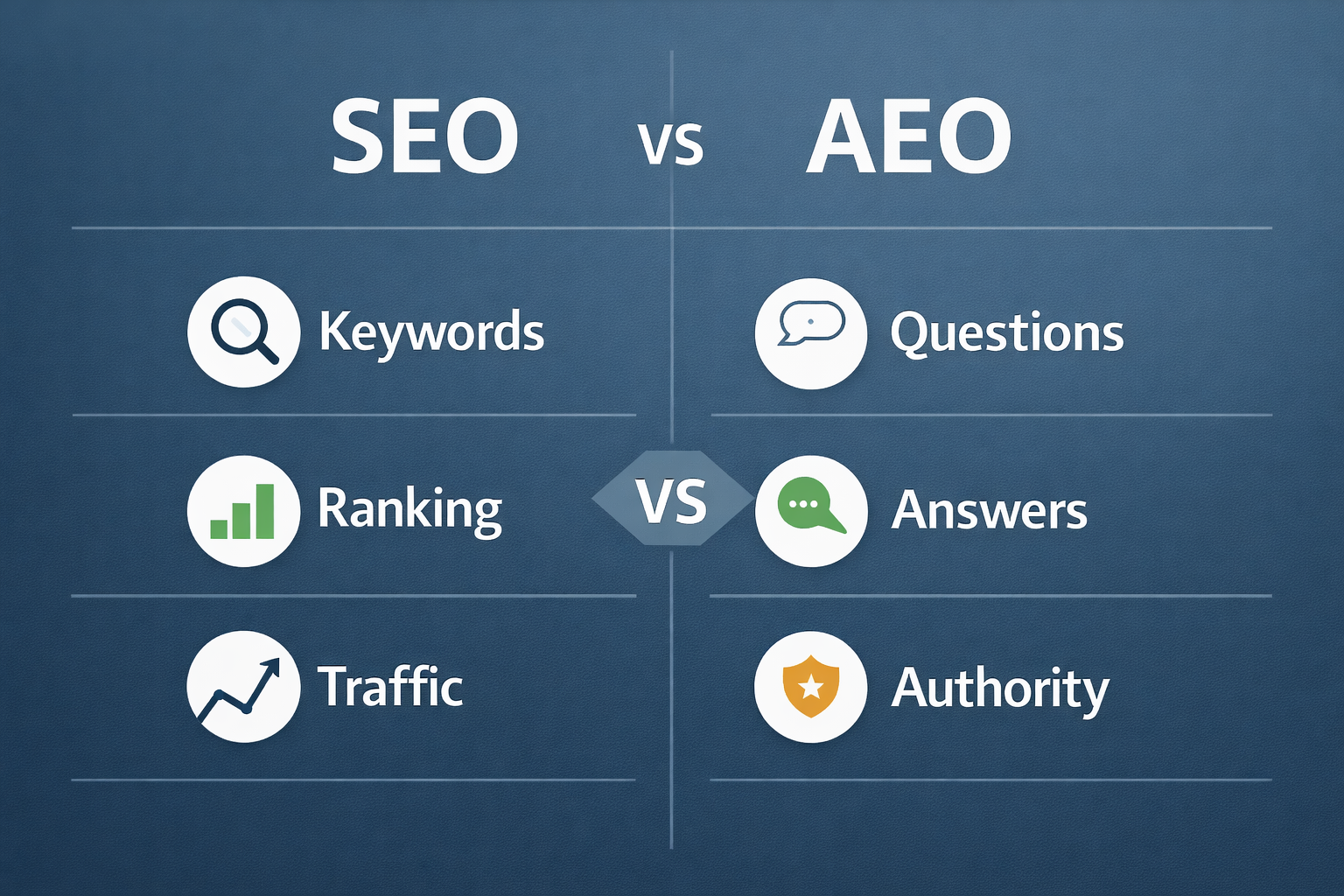
SEO vs. AEO: A Comparison
| Feature | Traditional SEO | Modern AEO |
| Primary Goal | Ranking for specific keywords | Becoming the “Cited Answer” |
| Content Structure | Narrative-heavy, long-form | Question-led, modular, and direct |
| Success Metric | Click-Through Rate (CTR) | Brand Authority & Citations |
| User Intent | Information gathering | Immediate problem-solving |
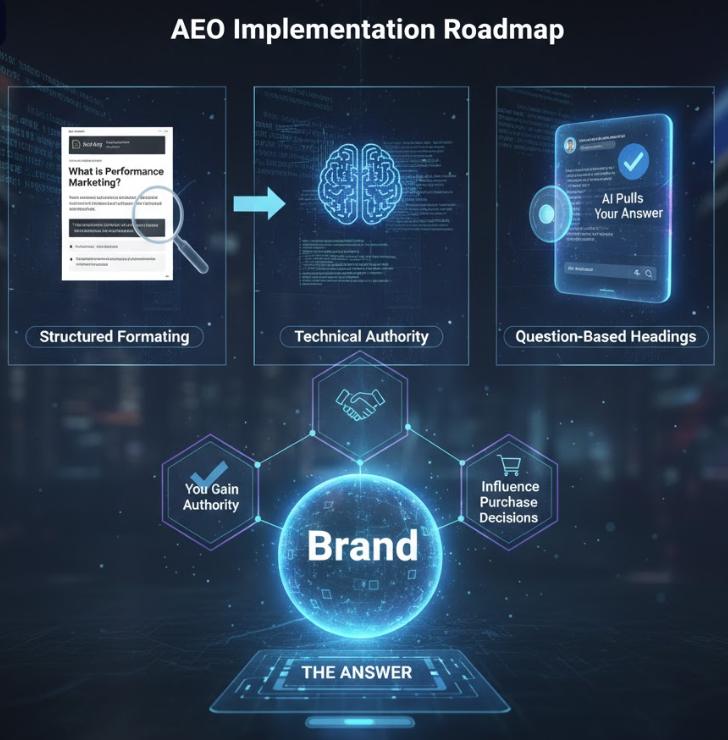
The AEO Implementation Roadmap
To survive the 2026 algorithm updates, you must bridge the gap between human readability and machine extractability. Here is how to optimize:
1. The “Answer-First” Writing Style
Gone are the days of “fluff” introductions. To capture the AI summary, you must provide the “TL;DR” (Too Long; Didn’t Read) at the very top. Use the Inverted Pyramid style: give the direct answer in the first 2–3 lines, then expand into the nuances.
2. Strategic Question-Based Headings
Structure your articles around the exact questions your customers are asking.
-
- Bad: “Performance Marketing Benefits.”
-
- Good: “How does performance marketing increase ROI for Kerala startups?”
3. Lean into “Synthesizable” Formatting
AI agents love structured data. It’s easier to parse a table or a list than a 500-word block of prose.
-
- Use Bullet Points for processes.
-
- Use Tables for comparisons.
-
- Use FAQ Schema to explicitly tell the engine: “Here is the question, and here is our answer.”
4. Technical Authority (Schema & E-E-A-T)
In 2026, AI prioritizes “Truth.” Implement advanced Schema Markup to help AI understand the context of your data. More importantly, double down on Experience, Expertise, Authoritativeness, and Trustworthiness (E-E-A-T). AI is more likely to cite a source that has verified credentials and a history of accuracy.
Why This Matters for Your Bottom Line
You might ask: “If they don’t click my website, why do I care?“
In 2026, Visibility is the new Traffic. When an AI pulls your content as the answer, it builds a level of brand trust that a standard ad never could. You influence the purchase decision at the moment of inquiry. If the AI says, “According to [Your Brand], the best strategy is X,” you have already won the psychological battle for authority.
Conclusion
Be the Answer, Not Just a Result
In 2026, the goal of digital marketing has shifted. It is no longer about being one of the ten links on page one; it is about being the one answer that the AI chooses to provide.
By embracing AEO, you aren’t just chasing algorithms; you are providing better value to your audience by being clear, concise, and authoritative.
FAQ
What is the main difference between SEO and AEO?
While SEO (Search Engine Optimization) focuses on improving a website’s ranking for specific keywords to drive clicks, AEO (Answer Engine Optimization) focuses on structuring content so AI models can extract direct, concise answers to user queries.
Why is AEO becoming more important than SEO in 2026?
Search behavior has shifted from “keyword hunting” to “conversational inquiry.” With the rise of AI-generated overviews and voice assistants, users now expect immediate answers on the search results page, often resulting in “zero-click” searches.
Does AEO replace traditional SEO strategies?
No. AEO is an evolution of SEO. You still need a technically sound website (SEO) to provide the authority and infrastructure that allows AI models to trust and find your answers (AEO).
How can a small business in Kerala start with AEO?
Start by identifying the top 10 questions your customers ask. Create a dedicated FAQ page and use “Question-based” headers (H2s and H3s) in your blog posts, providing the direct answer in the first two sentences.
About the Author
This article was written by Parvathy Vinod, a Kerala-based Digital Marketing Strategist and Web Designer specializing in SEO, AI-driven marketing, and conversion-focused websites & content strategy.
Learn more about my experience and projects on the About Page